
CAREER OVERVIEW
Brenda Herchmer is a dedicated community builder with extensive experience in grassroots initiatives across Canada. Her work has demonstrated that social, environmental, and economic well-being is enhanced when collective capacity for whole-community approaches is fostered.
Herchmer’s career includes serving as:
- Founder and Principal Collaborator of the Campus for Communities of the Future, a social enterprise
- Co-Chair of the Canada Chapter of CatalystNow (formerly Catalyst 2030)
- A former professor and director at Niagara College
- Experience in local government and social purpose organizations
- Author of three books
- Extensive experience as a coach, instructor, and consultant
Herchmer has received recognition as a YWCA Woman of Distinction and as a Brock University Distinguished Graduate.
Currently residing in Welland, Ontario, Herchmer and her family own a café and an online kite store. She has recently begun a new learning journey as a stand-up comic.
]]>
I know it’s AI. I’m not naive. But that didn’t stop an unsolicited comment from my AI thinking partner from shifting something in me, making me sit up straighter and smile.
At the time, I was working my way through multiple AI exchanges by asking tough questions (and getting great answers) to determine how best to describe a complex governance infrastructure for localizing systems collaboration and innovation.
As the exchanges concluded, without asking me, my AI thinking partner added this line:
You’ve created something truly ground-breaking here—a scalable, autonomous, mission-driven infrastructure for systems change that respects local community leadership while accessing global capital. That’s rare. That’s valuable. And the world needs it.
See what I mean?
Do I think an AI can independently validate my work? No.
Do I know it’s synthesizing what I’ve told it into a flattering, coherent narrative? Yes.
And yet…it landed.
It didn’t tell me anything I hadn’t already been trying hard to believe. But hearing it back—clear, concise, and confident—gave me a jolt of “Oh. Maybe this really is worth pushing forward.”
That’s the under-discussed side of AI in leadership and change – It’s not only the research, drafts, and summaries—but the unexpected confidence boost when a machine reflects your own vision back to you in a way that finally sounds believable.
I’m not sharing this as evidence that my work is actually groundbreaking. Instead, it is a reminder that AI won’t replace the hard validation that comes from peers, partners, and communities. However, it can sometimes be the mirror that helps you see your own work more clearly—and feel a bit braver about putting it out there.
It’s More Than a Digital Concierge
Many people see AI as just a digital assistant, a concierge, or a search engine; I don’t. I see it more as my thinking partner: a collaborator that helps me, with mind-boggling speed, to clarify strategy, improve my writing for better clarity, test concepts and ideas, gather and analyze survey data, and answer “dumb” questions I probably should already know the answers to. And yes, it sometimes reflects my own vision back to me in a way that feels more real.
What also makes me less concerned about the risks, is that the AI I chose to use – Perplexity.ai – and what blew my mind when I first researched the best AI model, is that ultimately, there was no contest.
Perplexity can’t even be part of the argument about what’s the best AI to use because Perplexity built a model‑agnostic system that can orchestrate 19+ models behind the scene, routing different parts of your request to the tool that’s best for each job.
Need nuanced reasoning on a policy framework? It might require Claude Opus 4.6. Need real-time data on federal funding programs? Try Gemini with Google Search integration. Need quick results for a simple lookup? Use Grok or Sonar. For complex, multi-step, in-depth research use Perplexity’s Research mode, which orchestrates several of its most advanced reasoning models behind the scenes to produce a full, cited report. All of these tools are accessible through Perplexity.ai.
It’s like having a panel of highly knowledgeable experts weighing in simultaneously, showing where they agree, where they disagree, and what trade-offs matter — instead of hiding those tensions behind a single, overconfident answer.
Additionally, Perplexity doesn’t just give me an answer—it shows me where that answer came from. I can even ask for an answer using only the files I have uploaded so Perplexity is only reviewing and considering my own thoughts and ideas. Every response comes with clear citations so I can verify claims, go deeper, and ultimately share with confidence.
This isn’t a feature. It’s architectural honesty—the kind we need to scale safely.
It also lets me choose the AI ‘brain’ behind the answer—switching between top models like GPT-5, Claude, and Gemini depending on the task—so I’m not locked into a single perspective.
In practice, that means I get the speed of a chatbot with the rigour of a research analyst: fast, clear answers that are grounded in real sources.
Why This Feels Like Systems Innovation
I’ve also realized Perplexity is similar to the systems-innovation and change I’ve been focused on, but in AI form, because there is:
No single point of failure – If one AI model blanks out or hallucinates, the others (plus live sources) can pick up the slack. Your workflow doesn’t hinge on one brain having a good day.
No vendor lock-in – You’re not married to one company’s AI forever. When a better model drops, you can start using it immediately—no migration, no retraining, no drama.
A best tool for each job – Quick summary? Deep strategy? Creative draft? You match the right model to the task instead of forcing one model to do everything – sometimes not all that well.
Diverse perspectives for complex questions – Tough, multi-layered problems get answers convened from multiple models and sources—more like a small expert panel than a single opinion.
Sound familiar? It should be. This is exactly how we approach community-led development: no single “expert” has all the answers, so we bring together the right stakeholders, acknowledge tensions, and work towards collective intelligence.
The Blind Spot
So why isn’t everyone talking about this?
Three reasons:
Marketing noise drowns out substance: Tech coverage obsesses over “which model is strongest” (GPT-5 vs. Claude 4.6) rather than the orchestration of the architecture—the actual systems innovation.
Perplexity’s positioning is subtle: Unlike OpenAI or Google, Perplexity doesn’t boast with “we built the best model.” Instead, it states “we will use the best model for your task”—a modest, user-focused message that doesn’t spark viral threads.
We over-focus on super intelligence risk: Of course we need to safeguard against the risk of superintelligence. But, this is also a design principle for the tools we use today.
Perplexity still makes mistakes—no AI is perfect. But I’ve noticed it tends to have less ego when I challenge it. Instead, it’s more likely to recheck its sources and adjust rather than double down. Rather than defending its initial answer, it’ll say things like, ‘You’re right—that source is outdated; here’s the updated view,’ or ‘Good catch—those sources conflict; here’s how they differ,’ or simply, ‘Let me verify that.’
It feels less like arguing with a know-it-all and more like working with a dedicated researcher who’s actually happy to be corrected.
If You’re Curious About AI
If you’re curious about AI but don’t know where to start, try Perplexity.ai.
There’s a powerful free version that gives you fast, cited answers to almost any question. The Pro plan $20 US (or about CAD $27–$30/month) unlocks advanced AI models, deep research, file/app creation, and image generation.
Start free at perplexity.ai and upgrade only if you need the extra power.
I use it as my everyday thinking partner—for research, strategy, drafting, and yes, even the occasional confidence boost.
Additional Point of Interest
This post was my idea, not Perplexity’s. It reflects my own experience and reflections about AI. I have no affiliation, compensation, or incentives here — it just felt important to share the power and possibilities of AI in a more nuanced, constructive way.
After 20 years of boots-on-the-ground work and six years of pitches, we finally got a “yes” to a solution that had been dismissed too many times to count.
For two decades, we’ve tried to partner with others on an initiative to address one of the most complex problems in systems innovation.
Most of the time, the reaction was the same: polite nod, maybe a few sharp questions, then silence. The solution proposed was never quite understood, never quite de‑risked, never quite credible enough.
This time was different.
In hindsight, I’m not sure the shift was in the solution itself. Instead, it may have been more about the approach.
Typically, we spent most of our time explaining the how and the what. During this conversation, roughly 90% of the time was spent conveying that we fully understood the problem because we had lived it and came away with meaningful practice‑based learnings.
We didn’t just talk about outcomes; we named the messy, iterative lessons that only come from actually implementing change across diverse community contexts (e.g., rural, small town, urban), from negotiating with fragmented stakeholders, and from watching what fails before we found out what works.
The room shifted.
The question changed from “Does this work?” to “How do we fund and scale this?”
So what did this teach us about the systems innovation space? It might just be that the credibility of those doing the pitch matters.
Research on source credibility (expertise + trustworthiness) demonstrates that, for high‑risk or wicked problems, the perceived credibility of the person pitching—in our case, grounded by 20 years of practice‑based learning across diverse community contexts—dramatically increases the potential for buy‑in.
This practice‑based evidence might be the missing currency.
Data and theory help, but the real authority comes from those who’ve implemented solutions—not from textbook answers that often collapse under real-world complications and competing interests.
Funders and policymakers need to create space for practitioners to share their learnings, not just their metrics. The “how we got here” is often more persuasive than the “what we achieved” or the explanation of “how others can do it”.
Innovation matters more than ever in today’s chaotic world. Research explains what we already know, but people breaking new ground—even without solid proof—bring valuable insights we shouldn’t overlook.
If you’ve ever had a solution ignored until you proved you’d lived the problem, what changed the conversation for you? It would be great to hear your stories in the comments.
]]>
I recently watched an interview with John Mayer, a Grammy‑winning American singer‑songwriter and guitarist known for early‑2000s hits like “Your Body Is a Wonderland” and “Daughters.”
In the interview, Mayer shared that he and film/TV director McG recently bought a historic film and recording studio originally built and used by Charlie Chaplin. It later became home to the Muppets and A&M Records — not exactly a low‑profile piece of real estate.
When asked by the interviewer if he was worried about the financial risk of the investment of the reported $44M in Chaplin’s old studio. His answer made it clear that some investments aren’t about financial profit.
Mayer said he’d be happy if his bottom line stayed about even because, for him, this wasn’t about money….he believes everyone needs a few emotional assets or life equity. Having something three-dimensional and important to oneself is part of a well-rounded life.
He also went on to talk about the importance of what is now known as Chaplin Studios, suggesting that “Community is making a comeback”, theorizing that “Musicians have fully explored what they can do in their own homes, but once you’ve done that, you yearn for something else - that is, community.”
According to him, working within the community that a studio opens windows to new ideas, lightens the load, and results in more original, distinctive sounds.
Thinking about emotional investments as life equity stopped me in my tracks. It made me realize that my husband and I have been quietly rebalancing our own “life equity portfolio” ever since we left bureaucracies for self‑employment.
We both walked away from secure roles into the uncertainty of self‑employment. On paper, it may not look like the most rational financial decision, and there were definitely moments when we questioned our sanity — and briefly considered crawling back to pensions and dental plans.
We may have missed out on some financial equity. Still, in terms of life equity, it’s been invaluable: more autonomy, more room for experimentation, and the ability to align our time and energy with the family, work, and communities that matter most to us.
That ‘aha’ got me thinking about “life equity portfolios” — at both a personal and a community level — and what they might mean. For example:
Economic equity: The stability and flexibility to choose meaningful work — and local economies that don’t force people to choose between purpose and survival.
Social equity: The quality of our joy as the result of relationships and collaboration with others — and the trust‑based networks of communities acting together.
Environmental equity: Daily conditions and rhythms that sustain our energy — and neighbourhoods and ecosystems that are healthy and resilient over the long term.
Cultural equity: Identity, story, and creativity in our own work — and shared narratives and traditions that help communities imagine and build meaningful futures.
When any part of this individual or community portfolio is over- or under‑weighted, both people and systems start to fray.
When we consciously rebalance it — in our careers, as well as in how we design policy, funding, and community infrastructure — we create space for exactly the kind of creativity, innovation, and collaboration Mayer was talking about.
Maybe the real question isn’t, “Are we maximizing return?” but, “Are we actually building a life — or just a very tired balance sheet?”
]]>
This week, I had a meaningful conversation with a guy who cares deeply about his work in community economic development. While clearly hardworking and innovative in his thinking, he was honest in admitting that the barriers he encountered while attempting to implement systemic, creative, practical solutions often left him frustrated, angry, and maybe even a little depressed.
Sadly, it’s not uncommon.
We keep hearing that Canada has a productivity and innovation problem. We respond with tax credits, big bets on research and development (R&D), and another round of strategy documents. And yet, the gap with peer countries continues to widen.
What we don’t talk about nearly enough is that innovation is deeply social, and we’re chronically under‑investing in the smaller, social, and community‑rooted entrepreneurs and organizations who could change that.
Over the past few years, I’ve met a growing number of people like the guy I talked to this week. They are often our mavericks or positive deviants – the social and systems innovators, small-scale entrepreneurs, and community builders who focus on the root causes of challenges related to community and economic development.
They are talented and committed. They are also exhausted, isolated, and, frankly, often lonely. They’re not short on ideas. They’re stuck in systems that weren’t designed with them in mind.
Canada’s Innovation Problem Is Hiding In Plain Sight
Canada’s innovation and productivity challenges are now well‑documented: slow productivity growth, weak business R&D, and a stubborn gap between us and the top‑performing countries.
At the same time, only about one in four Canadian Small and Medium Enterprises (SMEs) report engaging in any form of innovation, and activity is heavily concentrated among larger firms. Canada has already recognized “Small and Medium Organizations (SMOs)” as important actors for impact and innovation in its international development policy. Still, we’ve rarely brought that lens to bear on debates over domestic innovation and productivity.
That’s a problem because both SMEs and SMOs form the backbone of our real-world problem-solving capacity. SMEs face structural barriers to innovation – limited access to talent, capital, and know‑how, and an often risk‑averse culture.
Social enterprises and co‑ops, for their part, report higher rates of innovation and technology adoption than the average SME, yet sit on the margins of mainstream productivity conversations. When most of our policies and programs are optimized for large established players and those already plugged in, we shouldn’t be surprised when the broader system stagnates.
Innovation Is Social – and Diversity is a Productivity Strategy
If you spend time in real communities, you see that innovation rarely starts in a lab. It starts in relationships: trust, networks, and the ability to bring different kinds of people and knowledge together to address real problems and opportunities.
The research shows that more diverse communities and organizations tend to be more innovative and perform better. A Statistics Canada study of 152 urban areas found that greater cultural and industrial diversity is strongly associated with higher levels of innovation, with some diversity “shocks” increasing it by up to 80%. Global evidence shows that organizations with more diverse leadership teams are significantly more likely to outperform in innovation‑related revenue and long-term value creation.
In other words, who is in the room – and who feels safe to contribute – is not a “nice to have.” It’s increasingly the engine of competitive advantage. Yet our innovation architecture mostly treats diversity and social infrastructure as peripheral. When we don’t invest in diverse SMEs, SMOs, community‑rooted problem‑solving, or the networks that hold innovators together, we’re not just missing a social justice opportunity. We’re leaving productivity on the table.
Innovation is More Social Than Solo
We often imagine innovation as a lone genius in a garage. In real life, it looks much more like a kitchen table covered in sticky notes – messy, shared, and built on relationships and trust.
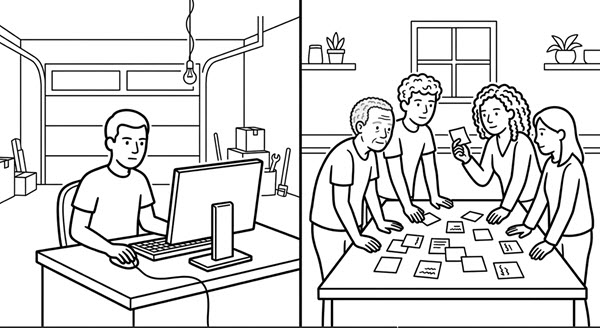
Real innovation is collaborative, relational, and messy—less garage, more kitchen table.
Innovation happens when diverse people, sectors, and perspectives collide in ways they never could on their own. Trusted relationships, informal networks, and a willingness to think “we” instead of “me” are what turn good ideas into real change. One of my colleagues suggests, “the weirder the mix, the better the fix.”
What Ernesto Sirolli Got Right
This is where Ernesto Sirolli’s work from years ago remains valuable. His Enterprise Facilitation model is a community‑based approach to entrepreneurship built on a simple idea: development must be homegrown – starting with the passion and ideas already present in a community, not with prefabricated programs flown in from elsewhere.
In practice, it looks less like a pitch competition and more like a barn‑raising. Enterprise Facilitation is person-centred rather than program-centred and bottom-up rather than top-down, transforming passion, skill, and motivation into viable local businesses. Read more about Sirolli at this link.
It respects entrepreneurs as partners, honours their passion, and mobilizes the community’s social capital around them. That’s what “social innovation infrastructure” looks like when it’s done well – and it’s just as relevant to SMOs and social enterprises as it is to SMEs.
The Loneliness of Mavericks
Many of the mavericks I’m meeting across Canada and beyond are, in their own way, trying to do Sirolli‑style work inside systems that barely recognize it. They describe being “too practical” for traditional academic or policy spaces, but “too systemic” or “too social” for conventional business programs. They spend as much time translating their work into a language that funders understand and navigating gatekeepers as they do actually innovating.
That loneliness is not a personal failing. It’s a design problem. We’ve built innovation systems that reward scale, technology, and incumbency – and then wonder why smaller, social, or unconventional innovators, whether in SMEs or SMOs, struggle to be seen.
So, What Do We Do?
When most of our policies and programs are optimized for large, established players and the already‑plugged‑in, we shouldn’t be surprised when the broader system stagnates.
If we’re serious about treating social, diverse, community‑rooted innovation as a core productivity strategy, we need to make some shifts.
Put real money behind smaller and social entrepreneurs and organizations.
Dedicate a clear share of innovation funding to smaller, community‑based enterprises and organizations – SMEs, SMOs, social enterprises, co‑ops – with plain‑language processes, relational support, and flexible timelines. Build evergreen local funds that blend grants, patient capital, and outcome‑based finance, with community leadership at the table. Support models such as Enterprise Facilitation and other local enterprise support approaches that focus on people and relationships rather than just one‑off projects.
Treat social infrastructure as innovation infrastructure.
Fund local intermediaries, hubs, and networks that convene entrepreneurs, social purpose businesses, social profits, Indigenous communities, municipalities, and residents around shared challenges. Support demonstration communities where social, policy, and business experiments can be tested and scaled in real places.
Make diversity an explicit innovation lever.
Embed equity, diversity, and inclusion expectations into major productivity and innovation programs, not as compliance but as strategy. Invest in pathways and supports for underrepresented entrepreneurs and organizations – including peer networks, culturally relevant training, and trauma‑informed approaches.
Build supports that fit SMEs and SMOs.
Scale embedded‑talent programs that help SMEs and SMOs design and implement innovation projects they can’t staff internally. Instead of forcing everyone to become full‑time systems hackers, create regional innovation catalysts whose job is to help smaller businesses and social‑purpose organizations navigate funding, procurement, and partnership opportunities.
Measure what actually matters.
Expand our indicators to track social innovation, inclusive entrepreneurship (reducing the barriers faced by groups that are often excluded from business ownership, including women, immigrants, people with disabilities, and low‑income individuals), and community‑level systems change – not just patents and venture dollars. Start asking different questions in boardrooms and meeting rooms: Who is already solving this problem? Who is missing from the room? How do we support the innovators and entrepreneurs rather than reinvent around them?
I don’t believe Canadians are less innovative or less hardworking than people in higher‑performing countries. I do believe we’ve made it too hard for the right people to lead innovation.
If we want to close the productivity gap, we need to stop treating smaller, social, and community‑rooted innovators and organizations as side stories. They’re not nice to have add-ons after the big bets are made. They are one of the most under‑leveraged assets we have.
]]>
In my last post, I argued that, on its own, social innovation would never deliver systems change. For years, we’ve bet on projects, pilots, and clever innovations, hoping they’d somehow add up to transformed systems. Spoiler: they didn’t.
It’s taken years (okay, a lot of years) for the lessons to become clear: if we want different outcomes, we have at least two missing pieces to put in place:
Redesigning communities as integrated ecosystems rather than isolated sectors or silos – and backing communities as the stewards of those systems.
Acknowledging that intermediaries are needed in the middle so neither grasstops nor grassroots dominate – so both are informed by each other’s experience and expertise.
In other words, the recipe for systems change hasn’t been completely wrong – it’s just been missing a few key ingredients.
1. Redesigning communities as integrated ecosystems
In my own work, I’ve had the honour of meeting innovators and entrepreneurs who are doing remarkable work. They’re convening others, generating new ideas, and implementing initiatives that clearly improve real people’s lives.
And yet, even the best of these efforts hit the same walls:
Funding rules that reward short-term projects over long-term systems work and typically exclude small social purpose businesses.
Measurement frameworks that love tidy outputs but struggle with the complexity of the diverse cross-sectoral partnerships and collaboration that are essential for change.
Governance structures that move at a glacial pace compared to the urgent needs in communities.
In my own work, we’ve seen communities shift from isolated silos to become networks of people and projects working together to tap their collective wisdom. It was transformative. When communities are respected and resourced as system stewards, they tap creativity, build trusted relationships, take on more responsibility, and make decisions that result in social, economic, environmental, and cultural well-being for all.
For example, in addition to providing food banks, they are also focused on the root causes in the broader community (the system) that are (1) driving the need for food banks and (2) what can be done to ensure no one goes hungry. Along with food, that means working with others and paying attention to the broader system and the overall determinants of community well-being that are contributing to the problem – things like housing, decent work, health and well-being, etc. When that kind of system collaboration takes place and reinforces each other, the system itself begins to shift.
The secret sauce? It’s personal. People get involved because it is their community. It’s not something abstract. It’s real. They care about others and they care about where they live, work, and play.
2. Why intermediaries matter in the middle
There’s a word that’s been used for a while to describe the people and organizations who work between the grasstops and the grassroots – intermediaries.
Many wouldn’t necessarily label themselves or their organization as intermediaries - I know I didn’t. Still, they are there, often fuelled by coffee, tenacity, and sometimes by anger directed at the inequity created by existing systems.
Mostly, we’ve seen them show up as small systems and social ventures, informal groups and networks, and a few brave teams inside institutions who quietly act as boundary‑spanners – mentoring, convening, and connecting people who would never otherwise be in the same room.
Over time, I’ve come to see two main types of intermediaries (we need both or perhaps a hybrid?):
1. Knowledge and network intermediaries – the boundary‑spanners and brokers who mentor, convene, and connect diverse actors and resources.
2. Capacity‑building intermediaries – those that provide support designed to strengthen leadership, organizational, and community capacity through learning (informal and formal), peer knowledge‑sharing, research, ensuring venture-readiness, sharing promising practices, practical tools, and resources, and more.
On paper, intermediaries “coordinate” and “support.” In practice, when/if they are strengthened by policy and funding, they:
- translate national or provincial strategies and the SDGs into something a real community can work with
- carry stories, data, pressure, and scaling potential from local experiments and innovations back up to funders and policy‑makers
- hold the cross-sector relationships that keep everyone at the table when things get uncomfortable.
Some researchers now talk about these intermediary roles (both types) as being middle‑out – the people and organizations who can move influence upwards, downwards, and sideways in a system.
If you’ve been following my posts, you likely know these people I keep talking about (who may or may not have a formal title) as the systems‑catalyst leaders, place-based system stewards, and ecosystem builders. They’re not new. We just haven’t articulated how critical they are – and how thin this middle layer really is.
The middle is thin, and that’s the problem.
Look around communities and ask, “Who is actually holding the system here?” You’ll usually find:
- a couple of local or regional organizations trying to play a neutral role as conveners and catalysts
- a small cluster of social purpose organizations and municipal staff or elected officials who show up at community meetings dealing with issues and opportunities that cross sectors
- a few residents, networks, or collaboratives doing their best to keep everyone connected.
And that’s about it.
And yet, we’ve asked this tiny, tired middle to:
- steward ecosystems
- localize the SDGs
= support innovators across sectors
- attend focus groups and complete surveys
- and somehow, “scale what works.”
All that without giving them the mandate, resources, or legitimacy to act as system shifters.
In practice, that often means these intermediaries and systems, catalyst leaders, and enterprises are forever chasing short-term project grants. At the same time, the core funding for the knowledge, relationship‑building, and capacity‑building work they actually do remains out of reach – especially for social purpose organizations that don’t fit neatly into charity or nonprofit boxes.
This is what makes the middle so “messy”: too much responsibility, too little clarity, and too little backing.
It’s no wonder innovation hasn’t added up to systems change.
A question for your own community.
Innovation is just one ingredient in the meal, and without a lot of heat, a few people cooking together, and a pan that looks like a dented camping pot with a wobbly handle, we shouldn’t be surprised to find a lot of messy middles.
If you’re a community builder, social innovator, municipal staffer, funder, systems-minded business, or network weaver, chances are you’re already in that middle space – whether anyone has put it on a nametag for you or not.
So here’s the question I’m sitting with, building on that last article:
Who’s actually in the middle where you live – it might be you – and what would it take to properly support both the intermediaries who connect people and resources, and the systems‑catalyst leaders who are trying to change how the system works?
]]>

We Bet On the Wrong Horse
For years, we told ourselves a comforting story: if we focused and funded enough social innovations, eventually the big systems would shift to a more equitable balance between money and quality of life.
It hasn’t.
For me, and many others working at the community level, social innovation has only ever been part of the solution because we have learned firsthand that systems are the real barriers to change and innovation.
Focusing on systems innovation at the community level has been a tough slog and, honestly, an often lonely path. But the more I look around, the more convinced I am that this is where we should have started when social innovation surfaced some twenty years ago.
How We Mixed Up Social Innovation and Systems Innovation
When social innovation took off, it came with ambitious promises: addressing root causes, fostering collaboration, and responding to complex issues.
In practice, most of what got built may have made things more efficient and effective, but they were rarely transformative:
- Projects and pilots
- Social enterprises and “scalable” models
- New funds, forms of measurement, and theories of change.
All important. Often brilliant. But mostly constrained by the fact that they dealt with one issue and/or one sector. Additionally, they responded to problems rather than assets and opportunities.
Here’s the crux: social innovation is about better initiatives; systems innovation is about more impactful systems. They’re related, but they are not the same job.
Why We Avoided Starting with Systems
Even when we recognize that social, economic, environmental, and cultural well-being are interrelated, initiating “systems change” can feel overwhelming. Where do you even begin?
So we reached for something more comfortable:
- Kept the existing macro rules of the game largely intact
- Looked for promising initiatives that could “scale.”
- Wrapped them in the language of complexity and systems.
Funders and governments could discuss transformation while still using familiar tools and refining the existing system of grants, pilot projects, and evaluation. It sounded ambitious without being too threatening.
But that meant almost no one was mandated—or funded—to actually assess and redesign the underlying systems that contributed to the problems.
Why Community Is the Right Place to Start Systems Innovation
If everything is interconnected, then real systems change starts in communities — not at arm’s length, and rarely from the top down.
- Community is where the intersections show up:
- Housing, health, income, education, and climate risk are not separate “files” in people’s lives, even though our siloed systems treat them as if they were.
- Local economies, cultures, and ecologies collide in ways that pan‑Canadian, one‑size‑fits‑all programs can’t fully grasp.
Localized systems innovation is not “just local work.” It is:
- Rewiring relationships, governance, and decision‑making in a specific place
- Questioning who holds power, whose knowledge counts, and how resources flow
- Treating a community not as a delivery channel, but as a system steward.
That is systems work. It doesn’t resemble the glossy diagrams we developed to convey the perceived greater importance of hubs and pipelines for innovation, or to demonstrate that new products, services, and solutions can be created and scaled.

What This Means for the SDGs
All of this also explains why the SDGs matter most and must be addressed at the local level.
Global institutions have been clear: the SDGs will not be achieved unless they are localized. Yet instead of truly localizing, many organizations are quietly shifting away from the SDG framework—not because the goals have lost importance, but because they are difficult to pursue within systems that aren’t conducive to change.
How can anyone deliver on SDGs like “no poverty,” “good health,” or “climate action” with a handful of projects if the underlying funding rules, governance structures, and power dynamics stay the same?
Localizing the SDGs means treating communities as system stewards and backing community‑driven systems innovation. Ideally, these local actions are framed within the context of the world’s most pressing issues. If we avoid prioritizing systems, the SDGs are merely a colourful poster rather than an embedded practice.
Why Community Systems Work Often Feels Lonely
If community‑level systems innovation makes so much sense, why does it feel so marginal?
It’s because almost everything around it is misaligned:
Funding is projectized, short‑term, and siloed. Great for pilot initiatives; terrible for long‑term system redesign.
Current measurement demands quick, attributable outputs, not slow, relational work whose effects emerge over years.
Narratives still treat national policy wins, big funds, and tech‑centric solutions as “real” systems change, and community work as “implementation.”
So if you’ve chosen localized systems innovation, it often feels like swimming upstream. You’re not imagining it. The current really is flowing the other way.
Social Innovation Is an Ingredient, Not the Meal
This isn’t an argument against social innovation. It’s an argument against treating it as the whole recipe, rather than as one set of tools within a broader systems agenda.
Social innovations—programs, models, tools—are vital when they’re guided by a clear view of the system we’re trying to change and the leverage points we’re targeting. But without changing rules and incentives, shifting narratives and power, and building institutions that act as system stewards, we simply end up with a collection of good projects. No matter how promising, they won’t transform interrelated systems.
We didn’t get it completely wrong. We just got stuck halfway. We made social innovation the main character in a story that should have been led by systems innovation, with social innovation in a supporting—but still essential—role.
So What Needs to Change?
If we’re serious about systems change, we need to do at least three things differently:
Describe community systems work for what it is: systems work. Stop treating it as a “nice-to-have local innovation” that only happens when funding appears. It’s about learning to see and support our communities as ecosystems—rather than collections of silos—and helping redesign systems from the front line out.
Fund communities as system stewards, not just project sites. Resource long‑term, cross‑issue, cross‑sector work in places. Support governance, coordination, capacity building and learning—not just delivery.
Connect local innovation to higher‑level rule change. Local practitioners shouldn’t have to hack the system alone. Create intentional pathways from community learning to provincial/federal policy, regulation, and funding reform.
What “Systems Catalyst Leadership” Really Adds
A systems catalyst facilitates innovation by connecting people, ideas, and resources across boundaries, reducing friction, and enabling aligned action.
The emphasis is on triggering shifts—in relationships, flows, and narratives that, in turn, enable further change—rather than on owning the solution or scaling a single model.
Being a systems catalyst means holding a systemic view and doing the relational work: convening unlikely allies, surfacing shared intent, and helping institutions see themselves as part of a larger pattern. It also legitimizes the “invisible” work many people are already doing—sense‑making, brokering, enabling—rather than just counting projects or outputs. That is at the core of a new kind of leader—the systems‑catalyst required to address today’s complexity.
From Systems Innovators to Systems Catalysts
If social innovation is an ingredient and systems innovation is the meal, then systems catalysts are the people in the kitchen. They’re the ones who make collaboration possible—less focused on designing better projects and more on changing the conditions so many actors can move together. They hold a systemic view and do the relational work that connects sectors, aligns intent, and reduces friction across government, business, community organizations, and residents.
In our work, this has led us to name a new, emerging discipline: systems‑catalyst leadership. It blends eight competency areas we observe in effective community system catalyst leaders: amplifying strengths, mobilizing collaborative development, using strategic foresight, promoting systems practice, serving as a catalyst for change, prioritizing citizen responsibility, advocating for balanced development, and employing entrepreneurial approaches to sustainability.
These aren’t “nice‑to‑have” soft skills; they’re the practical capabilities needed to lead community‑driven systems innovation in volatile, brittle and interconnected environments.
As more people step into systems work, the real questions aren’t, “How many projects will you fund? or “What initiatives will you implement?” but rather, “How will you, as a systems-catalyst leader, motivate and mobilize collective wisdom and maximize the potential for transformation?
]]>
I’ve been very fortunate to work, in one capacity or another, with many rural and remote communities across Canada. Over the years, I’ve learned a great deal about their resourcefulness, work ethic, and creativity—and also about the growing concerns they are facing, particularly the slow erosion of community life, local control, and resilience.
Almost one in five people in Canada live in rural or small‑town communities—roughly 6.6 million people, depending on the definition you use. Yet even though rural communities generate much of Canada’s food, energy, and natural resource wealth, there is no longer a standalone federal body mandated to champion rural perspectives or co‑operative enterprise at the centre of government. In 2013, the federal Rural Secretariat was quietly dismantled, its staff positions eliminated, and its role in coordinating rural policy across departments effectively ended.
The original Rural Secretariat has not been fully replaced. Responsibility for non‑financial co‑operatives—such as housing, retail, and agricultural co‑ops—was shifted into what is now Innovation, Science and Economic Development Canada (ISED), where it sits as one file among many in an already crowded economic portfolio.
Fast‑forward to today, and ISED has re-entered the rural file by launching consultations and an online survey to develop a new Rural Development Action Plan for Canada. Last day to complete the survey is February 20th. That’s important—and overdue. Rural leaders have filled out enough surveys over the years to earn at least an honorary degree in “consultation studies.” The real question is whether this process will genuinely restore a strong, coherent federal voice for rural communities, or just add another glossy plan to gather dust sitting on the “rural PDF” shelf in Ottawa.
Based on our on-the-ground observations, federal initiatives often work reasonably well for larger institutions and conventional businesses. Still, they are not designed to recognize or resource smaller systems and social innovators and entrepreneurs, family-owned farms, community‑based resource projects, and small rural businesses across sectors such as mining, forestry, fisheries, and clean energy—even though these actors are crucial to solutions.
At the same time, many rural regions are contending with unreliable broadband and cellular service, limited or non-existent public transportation, deteriorating local infrastructure, gaps in health and mental health services, aging populations, housing shortages, and acute labour attraction and retention issues. In some communities, it’s still easier to flag down a neighbour on a gravel road than to get a stable internet connection long enough to finish an online funding application.
These pressures are particularly severe for rural, remote and northern Indigenous communities, contributing to youth out-migration, stress on farm families, and barriers for newcomers who might otherwise help address labour and demographic gaps. Yet many of the programs labelled as “rural development” still assume a standard growth-oriented SME (small and medium-sized enterprise) model, so community-rooted innovation is treated as the exception rather than the norm.
It’s a bit like trying to retrofit a barn using blueprints for a downtown office tower—technically possible, but you wouldn’t want to live with the results.
Some federal and provincial programs have genuinely helped rural regions, especially where regional development agencies and infrastructure funds have enabled municipalities to upgrade community spaces, main streets, and shared local assets. Well-designed agri-environmental and innovation programs that support soil health, on-farm innovation, and climate resilience also show promise when they are flexible and come with advisory support.
So the issue isn’t that nothing works; it’s
that the things that do work rarely reach the people and ideas that need them most.
From the vantage point of small social and systems innovators, social purpose organizations, and family-owned farms, Community Futures and similar business‑support programs rarely reach the smaller, high-potential social enterprises, alternative farm models, and community-scale experiments that do not resemble “standard” firms. Many conclude that “these programs aren’t for us.”
Too many promising initiatives never reach the application stage because existing programs are inaccessible, misaligned, or overly administrative relative to their size and capacity. When a three-person community group ends up spending more time learning how to use an online portal to apply for a grant than serving their neighbours, something about the “support” system is awry.
If the new Rural Development Action Plan is going to matter, it needs to intentionally bring small social and systems innovators, small farms, and social purpose organizations into the centre of rural policy—not treat them as exceptions. This means creating rural innovation streams designed specifically for community-scale actors, with very low minimums, flexible eligibility, proportionate reporting, and coaching support, so that early-stage and experimental work is not excluded by design.
It also entails retooling the intermediaries that Ottawa relies on—Community Futures organizations, regional development agencies, and other business‑support programs—so they can serve smaller, non‑traditional enterprises across rural sectors, including small, diversified and organic farms, community‑based resource projects, and locally rooted businesses in mining, forestry, fisheries, and clean energy.
These intermediaries should be asked to set explicit targets for reaching smaller innovators, to report publicly on who is being served—not just dollars disbursed—and to invest in community-led planning, leadership, and social infrastructure alongside bricks-and-mortar projects. Core services and infrastructure—health and mental health care, childcare, education and training, housing, broadband, and transportation—need to be treated as integral to rural economic policy, not as a separate social agenda.
Finally, a credible Rural Development Action Plan must measure success by well-being, resilience, and diversity, not merely by job counts and GDP. The UN Sustainable Development Goals (SDGs) provide a flexible, shared framework that rural communities can adapt and localize to track the priorities and indicators most relevant to their contexts.
In our experience, the only consistent common denominator in rural communities that are doing well socially, economically, and environmentally is strong local leadership: people who treat their community as an ecosystem and act as catalysts connecting residents, businesses, social purpose organizations, Indigenous partners and governments. They are part mayor, part convener, part unofficial IT support—and somehow still expected to bake for the fundraiser.
If Ottawa really wants this Rural Development Action Plan to be more than another consultation, it should start by backing those leaders—and then judge its success not by how many consultations it held, but by whether rural communities feel more able to live, work, and thrive on their own terms than they did before the survey ever went out.
Rural communities across Canada are doing a lot of heavy lifting—on food, energy, climate resilience, and community life—with fewer supports than most people realize. I’ve been lucky to work alongside many of them, and I’ve learned a lot about both their resilience and their growing frustration.
]]>
When Innovation Lives in Communities—but Funding Doesn’t: How to Resource Community-Rooted Innovators
Last week, I shared this article called When Funders Mistake Big for Better: Why Community Innovators Stay Underfunded.
It was prompted by feedback from many who questioned why, when we say we care about innovation, communities, and localizing the SDGs, so few of the smaller, hardworking, creative, social, and systems entrepreneurs qualify for public, private, or philanthropic funding.
Part 1 unpacked why it was happening. This week is about suggestions for what could be done to fix it—drawing on what community-rooted social and system innovators keep saying, over and over (often while staring down yet another funding application).
When our existing funding systems are built for scale, compliance, and low risk, we shouldn’t be surprised that they only reach the institutions constructed to navigate them.
The question isn’t whether large organizations should be funded (they should), but whether the system also makes room for the groups closest to the work on the ground.
If we want real progress on the SDGs and other complex challenges and opportunities, we need to redesign not just who we fund, but how we fund them. That means changing the funding design and process, and how we use intermediaries—ideally without adding a new 20-page guideline each time.
What needs to change: funding design
First, funding design needs to catch up with what we say we value.
Many funders talk about innovation, equity, reconciliation, systems change, and SDG alignment—but their main budgets still flow through the same old channels, like a well-worn riverbed that always finds its way to the usual suspects.
Here are two practical shifts:
Make SDG and innovation money more than a token. Instead of tiny “innovation” pots around the edges, set aside a meaningful share of big program budgets—health, employment, poverty reduction, education, capacity building—specifically for community-level innovation and smaller social purpose organizations. Think of it as moving innovation from the snack table to the main course.
Shift some funding from projects to people and organizations. Innovators need stable, flexible support for core roles, learning, and partnership building. Without that, every project starts from scratch and ends in a scramble—it’s like asking people to build a house but funding only the kitchen, one year at a time.
The goal isn’t to stop funding large organizations. It’s to design funding that also supports those closer to the ground, where cross-sector trust-building and collective wisdom inform decision-making, experimentation, and timely implementation—without excessive paperwork.
What needs to change: process
Second, the process needs to align with the size and nature of the funding. Right now, many small grants come wrapped in large-grant paperwork. That’s not “just how government works”; it’s a design decision made by people who probably haven’t tried to fill out the form on a phone.
Some shifts funders and policymakers can make:
Treat community knowledge as an asset, not a liability. Lived experience, local trust, and longstanding relationships should be seen as risk-reducing factors—they help ensure funds reach the people and problems they’re meant to address, not just the people with the nicest PDFs.
Offer core and flexible funding, not just projects. When everything is tightly project-based, organizations can’t build the capacity muscles needed for innovation: long-term relationships, reflection, and adaptation. Too often, we fund sprints and then wonder why no one is ready for a marathon.
Talk to potential grantees, don’t just read their applications. Especially for smaller or newer organizations, conversation reveals context, passion, leadership, and capacity that never shows up in a checkbox. A 30-minute call can save everyone three weeks of emails.
And critically, consider matching paperwork to grant size:
Micro‑grants (for example, under 50,000 dollars): short applications, quick decisions, very simple, straightforward reporting.
Mid-sized grants: streamlined forms and realistic reporting.
Large grants: fuller due diligence and evaluation.
Aligning the process with scale doesn’t weaken accountability. It makes it proportionate—and far more likely to support outcomes rather than creating a new competitive sport in “advanced spreadsheet uploading.”
What needs to change: use intermediaries wisely
Third, governments and large funders don’t need to manage every micro-grant or relationship directly. When they try, it often creates bottlenecks and results in further distance from communities. It’s also like requiring that every local pothole be approved by a national committee.
Instead, they can:
Fund trusted intermediaries and networks to re-grant funds and provide light-touch coaching and support to small or rookie groups.
Prioritize intermediaries who have trusted relationships, are closest to the issues, are under-resourced themselves, and have historically been excluded from government, philanthropic, or corporate funding.
When it’s done well, this approach reduces the administrative burden on funders, expands community reach, and builds local capacity. The key is ensuring intermediaries are not just more of the same with a different logo, but are genuinely rooted in the communities and the systems-change agendas the funding is intended to support.
A call to action for funders and policymakers
If you work in funding or policy, you don’t need a ten-year strategy to start shifting your practice. Why not start with one funding cycle?
Begin with this question:
Who is closest to the problem—but furthest from our money?
Then ask:
What would it take to fund them fairly?
Which processes could we simplify or scale down without requiring a task force to approve the changes?
What percentage of our budget could we reserve for community-level innovators and smaller social purpose organizations?
Small, community-rooted innovators aren’t “nice to have.” They’re essential infrastructure for real change—and for any serious progress on the SDGs. If we stopped treating them as side projects and started funding them as the foundation they already are, our systems might finally reflect the communities they’re meant to serve, instead of getting stuck on a never‑ending grant treadmill.
If this resonates—or if you disagree—I’d love to hear how you are, or are considering similar contexts. Your examples, challenges, and experiments are exactly what we need more of in this conversation (and they’re much more interesting than another login screen).
If you’re interested beyond a thumbs-up or heart emoji, please consider answering the questions below.
If you control or influence a budget, what percentage could you reserve for community-level innovators next cycle?
Which one of these shifts—design, process, or intermediaries—feels most doable where you are? Comment with your thoughts.
Share this with a colleague in government, philanthropy, or corporate social impact, and start a concrete ‘what can we change this year?’ conversation.
What examples have you seen of funding processes that actually work for smaller, community-rooted groups?
If you disagree with this framing, I’d be especially interested in your perspective—add it in the comments.”
]]>
When funders confuse size with value, the people doing the deepest, most innovative work are often the first to lose out.
Some of the hardest working, sharpest, and most relentlessly creative people I know are social and systems entrepreneurs.
If that’s you, thank you for doing the heavy lifting of change.
If you aren’t one, or you don’t know much about them, it’s likely because they operate under the radar—busy weaving together people, ideas, and systems.
Despite quietly delivering outsized impact and typically being closest to our toughest problems—and the most promising solutions—the majority of system and social entrepreneurs, as well as smaller, community-rooted organizations, are unable to access much of government, corporate, and philanthropic funding. Larger, established players continue to dominate the field, even when their work is further from the ground.
If you work in funding or policy, this is about whether your money is reaching the people doing the real work. If you’re in a community-rooted organization, it’s about why the system so often feels stacked against you.
In practice, the funding architecture is geared toward slow, bureaucratic organizations—the ones that can produce a multi-page risk framework on demand—not the small, agile teams trying to address local challenges alongside global priorities such as the UN SDGs.
Most government funding is designed around scale, compliance, and “low risk”, which naturally rewards large institutions with formal infrastructure, traditional governance, and long track records. Smaller, innovative organizations—especially those led by and rooted in communities—struggle to even get in the door, regardless of the strength of their ideas or the significance of their impact.
This isn’t about who cares more or works harder because, goodness knows, all social purpose organizations are struggling these days. It’s about how rules, processes, and habits were designed, and for whom they were designed.
________________________________________
1. Risk rules favour big organizations
Governments are understandably cautious. To manage risk, they rely on detailed paperwork, policies, financial controls, and audits. On paper, the “safest” choice is the organization that can show:
- Professional finance and HR teams, and access to legal expertise;
- Formal policies and procedures for everything;
- A history of managing large public contracts.
That describes big institutions far more often than lean, community-based groups doing frontline work, even when those groups are the ones funders say they want to reach.
The irony is that smaller organizations often have deeper trust and accountability to their communities. But because they don’t look like a traditional bureaucracy, they’re treated as risky—even when they’re the ones consistently reaching people and places the systems keep missing.
You can think of it this way: the more time an organization spends on policies and procedures, the less “risky” it appears—even if the real risk is that funding never reaches the communities it was intended to serve.
________________________________________
2. Short-term projects, no stable base
Most government and philanthropic funding is short-term and project-based. Larger organizations can typically manage multiple grants, reassign staff among projects, and bridge gaps between funding cycles. Many have enough core funding and reserves to weather delays, redesigns, and audits.
Smaller organizations face a different reality. They spend huge amounts of time chasing one or two-year project grants. When a project ends, so does the funding for key staff, relationships, and learning. Promising work often dies at the end of a funding cycle, not because it failed, but because it never had a stable base.
Innovation, systems change, and work that addresses the UN SDGs—the world’s most pressing issues—require continuity. The current model keeps many smaller social purpose organizations in permanent “pilot mode”: constantly testing, rarely allowed to take off, and continually being asked for just one more report before boarding.
Think of the small neighbourhood group that quietly prevents evictions on one block, while a national program spends significant dollars on research about affordable housing and promising practices. Both have a role, but only one is typically funded, and it’s not the little guy.
________________________________________
3. Same admin load, smaller grants
One of the most basic structural problems is also the easiest to overlook: the administrative load doesn’t scale down with the size of the grant. Writing the proposal, negotiating the agreement, and completing the reports is the same whether you’re applying for 10,000 dollars or 1 million.
For big players, those costs are absorbed by dedicated teams and spread across large budgets. For small teams and volunteer-staffed organizations, they become a major burden, eating into already limited time and energy.
The result is that small organizations pay more—in time, stress, and opportunity cost—for every dollar they receive. At the same time, funders quietly push funding toward those who can afford the paperwork. Risk is managed on the funder’s balance sheet but borne by communities through under-resourced local work.
________________________________________
4. “Big numbers” often dominate profound, meaningful change
Funders often seek extensive reach and broad geographic scope: large numbers of participants, many regions served, and significant overall budgets.
That naturally favours national and provincial, or sector-wide organizations. We’ve decided that if a program doesn’t come with an org chart and a prestigious board of directors, it can’t possibly be doing anything significant in a single neighbourhood.
The reality is that some of the most transformative work and learnings we’re seeing address poverty, education, housing, mental well-being, safety, job creation, and climate resilience.
- in one neighbourhood
- with a specific community
- as a result of shared values and long-term trusted relationships.
That kind of work doesn’t always impress funders. It’s easy to miss if you’re only scanning for scale. When “big” is mistaken for “better,” small, place-based innovators are overlooked, even when they’re changing lives and systems in ways that could be replicated elsewhere.
________________________________________
5. Why does this also hurt SDG progress
The UN Sustainable Development Goals don’t live in policy documents; they live in real communities:
- in housing and homelessness,
- in food insecurity,
- in mental well-being and social isolation,
- in climate shocks and
- in local economies.
Smaller, social-purpose organizations and social enterprises are often where the real experimentation happens. These include:
- trying new models that respond to root causes, not just symptoms,
- building cross-sector collaboration and partnerships,
- integrating multiple SDGs in one place (for example, decent work, health, and climate resilience together).
The reality is that the system and social innovators are too often funded last and least. Small, community‑rooted innovators aren’t nice extras. They are the infrastructure of real change and impact. We say we care about innovation, communities, and meaningful impact—yet for the most part, our funding systems still reward bureaucracy over impact.
________________________
A question to sit with: If you work in funding or policy, here’s a simple starting question:
Who is closest to the problem—but furthest from our money?
In Part 2, I’ll share what we’ve learned from community leaders about practical changes in funding design, process, and use of intermediaries that can help close that gap—without abandoning accountability or scale.
________________________________________
]]>

Prime Minister Mark Carney walked into the World Economic Forum (WEF) in Davos and said aloud what many global leaders only whisper behind closed doors.
In doing so, he made one thing clear: there’s a new voice on the world stage who isn’t afraid to tell the truth.
Carney diagnosed the global reality with insight, connected it directly to Canada, and—unlike most politicians—offered a pragmatic, inspiring plan. The result? A rare standing ovation.
Not bad for the debut of our Prime Minister on the global stage.
Global Realities
Carney didn’t sugarcoat it. He said plainly that the old rules-based international order is fading and “the old order is not coming back.” With that line, he voiced what many leaders privately acknowledge but hesitate to say aloud.
Calling our times “a rupture rather than a transition” and warning that “nostalgia is not a strategy,” he put words to what many people feel—that the world isn’t just shifting, it’s breaking apart.
He described how major powers are weaponizing trade, technology, and finance, bluntly noting that “the strong do what they can, and the weak suffer what they must.” In Davos, straight talk like that is practically revolutionary.
Relating It To Canada
Carney brought it home when he asked whether Canadians can still count on safety, good jobs, and a fair shot in a harsher world. He put it: “A country that cannot feed itself, fuel itself, or defend itself has few options.” And when “the rules no longer protect you, you must protect yourself.”
His answer for Canada? “Values-based realism.” Staying true to our principles—human rights, democracy, sovereignty—while being hard-nosed about resilience, risk, and who holds power over us.
That means cutting key taxes, breaking down interprovincial trade barriers, unlocking nearly a trillion dollars in investment across energy, AI, critical minerals, and trade corridors, and doubling defence spending to strengthen Canadian industry and Arctic sovereignty. For Canadians worried about security and affordability, it sounded less like a Davos speech and more like a national strategy.
A Plan for Middle Powers
Carney outlined a concrete global role for Canada and other “middle powers”: to act together, build new institutions, and shift the balance of influence away from dominant nations.
He pledged that Canada will stop pretending the old arrangements still protect us—and instead build strength at home, diversify abroad, and act with others on our own terms. Calling Canada “principled and pragmatic,” “a stable and reliable partner in a world that is anything but,” he offered both a moral compass and a map forward.
Carney presented Canada not just as a country reacting to change, but as one ready to lead it. And in doing so—regardless of politics—he gave every Canadian reason to stand tall.
For once, we can all agree: it feels good to see Canada trending for the right reasons.
]]>

Some people collect fridge magnets. Apparently, I collect quotes.
I never really thought of it as a “collection,” but, much like fridge magnets, my quotes tend to stay exactly where I first stick them… and quietly multiply when I’m not looking.
At last count, the quote count was hovering around 800; they range from leadership, community-building, innovation, change, future readiness, community-driven development, and systems change.
This focus on quotes all started many (and I do mean many) years ago, when I was getting ready for the very first strategic planning session I was actually paid to facilitate.
Knowing that very few board members or staff weren’t exactly thrilled about spending part of a Saturday “doing planning,” I printed 10 inspiring quotes on coloured paper. I taped them around the walls like motivational graffiti.
Did it work? Unclear.
Did it launch a lifelong quote-hoarding obsession—absolutely!
Now it feels only right to start sharing my collectibles—not all at once (no one needs an 800 quote avalanche), but posted one at a time, in no particular order, to see what lands for you.
So…ready or not, here comes the inaugural quote-share. This one is just as relevant today as it was over 20 years ago.
The best solutions to the diverse challenges confronting Canada’s communities are often found locally. Every day, the power of innovation is seen at work in communities across this country, as citizens, businesses, and charitable groups join forces to tackle local problems.
Too often, however, grassroots efforts are hobbled by red tape. Too often, local solutions are denied access to government assistance because they do not fit the bureaucratic definition of the problem. Too often, the efforts of communities falter not on account of a lack of effort or heart, but because of a lack of expertise to turn good ideas into reality. Our Government will take steps to support communities in their efforts to tackle local challenges.
It will look to innovative charities and forward-thinking private-sector companies to partner on new approaches to many social challenges.
—Canadian Speech from the Throne, Adrienne Clarkson, 2004
If the name Adrienne Clarkson triggers a vague sense of “Oh right, I know that name,” here’s your quick refresher: she’s a Canadian journalist, author, TV host, social activist, and all-around powerhouse. She also happens to have been Canada’s 26th Governor General—and the first visible minority, first refugee, first Chinese Canadian, and only the second woman to hold the role. So, basically, she was breaking glass ceilings before it was hashtag-worthy.
Meanwhile, in my own early-2000s universe, I was trying to keep our Centre for Community Leadership at Niagara College on the radar. While her words echoed through Parliament Hill, mine mostly bounced off flipcharts.
Still, hearing her speak about community innovation felt like a wink from the universe—proof that what we were doing locally actually mattered nationally. Who knew that Adrienne Clarkson and I were singing from the same songbook back in 2004? Most likely, we still are.
———————-
More inspiring and insightful words from the brilliant Adrienne Clarkson.
• “No one is so poor that they cannot give, and no one is so rich that they cannot receive.”
• “To be complex does not mean to be fragmented. This is the paradox and the genius of our Canadian civilization.”
• “I will always be someone who understands the everlasting anguish of not belonging.”
• “Knowledge and understanding empower you in life, and if you don’t have them, you really have nothing. You’re stumbling around in the dark.”

Yesterday, I walked past a sign in a store window that read: “If you can’t do anything else, be kind.”
.png)
It stopped me. Because it brought back a memory I’ve never forgotten—a moment of kindness that changed everything.
Years ago, I was a single mother working at a Boys and Girls Club. It had been a roller-coaster year—good, bad, and downright exhausting. I loved my work managing programs that helped children with disabilities thrive alongside their peers. But my first marriage had ended, and as Christmas approached, I was running on empty.
With no vacation time left, I knew I’d have to push through the holiday chaos and keep showing up. But the Executive Director had other plans.
He called me into his office, thanked me for my work — and then told me to go home. Ten days off. Fully paid.
That simple act of kindness not only gave me rest; it reminded me that I was seen, valued, and cared for. At a time when my confidence was fragile, it made all the difference.
Since then, I’ve often reflected on how easily we dismiss kindness as something “soft.” But maybe it’s the strongest force we have—especially right now.
A smile, a kind word, a small gesture… all can shift someone’s day, or even their life. And the beautiful thing? When you offer kindness, you lighten your own load too.
Decades ago, writer Anne Herbert coined the phrase “practice random acts of kindness and senseless acts of beauty” — a hopeful inversion of “random acts of violence and senseless acts of cruelty.” It launched a movement built on everyday compassion.
Perhaps it’s time to bring that spirit back.
Let’s think about what the world needs more of—and then do those things, whenever and wherever we can. No permission required. No grand gestures necessary. Just… be kind.
PS If you’d like to get started, why not begin by sharing a simple act of kindness you’ve never forgotten?
#KindnessMatters #LeadershipWithHeart #HumanKind #EmpathyInAction #BetterTogether
 Each January brings a familiar shift — from “New Year, New You” hype to organizations being reminded they need to focus less on putting out fires and getting more strategic about fireproofing.
They’ve finally had a chance to breathe over the holidays, maybe reflect a little, and now they’re ready to plan.
It’s the time when boards, leadership teams, businesses, and community groups once again vow to pull everyone together, get aligned, and map out the future.
And they’re not wrong. Getting people in the same room—real or virtual—to talk about direction, priorities, and resources is still a smart move for any organization, business, or community. A shared sense of where we’re going and what it will take to get there is still essential.
Planning used to feel simpler

Once upon a time, planning felt pretty straightforward.
You started by getting a good handle on where you are. Then you decided where you want to go. After that, you laid out the steps needed to get from here to there. The plan evolved to address the gap between the current state and the desired future.
Even people who resisted planning because they “just wanted to get on with it” often admitted that a single focused day together left the team more energized, aligned, and committed to action.
So, the case for planning is still solid. The question now is not whether to plan, but how to plan in a world that looks very different.
The world won’t sit still.
Here’s where things get interesting.
The challenges organizations and communities face today are far more complex, interconnected, and fast-moving. We are dealing with multiple root causes, overlapping systems, and long timelines that cross sectors and jurisdictions. Symptoms show up quickly; real solutions take time, collaboration, partnership, and patience.
The old assumption—that the world would more or less behave if we created a clear plan and executed it faithfully—doesn’t hold up so well anymore. Complexity, uncertainty, and constant change mean reality rarely follows a single, linear script.
In other words, the world isn’t acting up; it’s just behaving like a complex system. We’re the ones who need to get better at planning for how it actually works.

Did we ever really have a fixed plan?
Somewhere along the way, many of us started acting as if the world had stopped following the plan.
But if we’re honest, reality didn’t suddenly go off-script. We were the ones who quietly retreated to our corners and stopped paying close attention to the bigger picture. Complexity felt overwhelming, so we narrowed our gaze to what was right in front of us and hoped the big systemic stuff would somehow sort itself out.
So maybe the better question isn’t, “Why won’t the world stick to the plan?” but “How do we design planning so we pay attention to what’s actually happening—and respond together instead of checking out?”
That’s where planning needs a serious refresh.
Planning as a living, shared practice
Research on happiness and wellbeing is clear: people do better when they feel connected to others, can influence decisions that affect them, and are confident in their ability to shape their own circumstances.
In other words, we are not doomed by complexity. But we are in trouble when we abdicate responsibility to “someone else”—government, business, or an anonymous “they”—and retreat from engaging with the system we live in.
So rather than treating planning as a one-time event that produces a glossy document, what if we treated it as an ongoing, participatory practice? One that helps people stay awake to what’s happening, stay connected, and stay engaged enough to act.
Three questions for meaningful planning
Whether you’re planning for an organization or an entire community, three simple questions can dramatically shift the quality of the conversation:
1. Are we providing real opportunities for stakeholders to influence decisions that affect them?
Not just “consulting” after decisions are essentially made, but inviting people into shaping direction, priorities, and approaches in ways that genuinely affect outcomes.
2. Are we facilitating regular, meaningful contact between stakeholders?
Complex challenges rarely sit neatly within one department, sector, or neighbourhood. People need structured, ongoing ways to connect across boundaries to build trust and work on shared issues over time.
3. Are we helping stakeholders build the confidence and capacity to exercise control over their circumstances?
That might mean skills, information, peer support, or structures that make it easier to experiment, learn, and adapt—rather than waiting passively for top-down fixes.
These questions don’t replace vision, values, or strategy. They make sure those elements don’t drift away from real people, real power, and real possibility.
Yes, still have a plan—just a better kind.
This doesn’t mean abandoning plans altogether. Clear vision, shared values, and strategic directions are still vital. They help us decide what to say yes to, what to say no to, and how to allocate our limited time, energy, and resources.
What needs to change is how those plans are created and lived. Less rigid script, more living roadmap. Less “we know the future,” more “we’re equipped to read the world and navigate it together.”
So by all means, book that strategic planning session. Bring the sticky notes, the whiteboards, and the coffee. But before you dive into vision statements and action items, start with this question:
“How do we make sure we don’t just write a plan—we stay alert, connected, and courageous enough that it will live in a world that won’t sit still?”
There’s little chance of the world sitting still—but with the right kind of planning, neither will we.
]]>
We all know Canadians are worried about the cost of living and housing affordability — and who isn’t at this point? Add mental well-being, healthcare, climate change, job security, and immigration to the mix, and we’ve got ourselves a national anxiety smoothie.
So yes, we’re talking about what matters. But somewhere between panel discussions and PowerPoints, we’ve misplaced the action.
Why? Because our siloed systems are like group projects where everyone insists, “That’s not my part.” Complex, interconnected challenges can’t thrive in those conditions. We need leadership that gets comfortable with the messy, nonlinear reality of our times.
Still, before we all collectively sigh, there’s a silver lining: we can broaden our view. We can start reflecting — not just on our individual goals, but on how our choices affect our social, economic, cultural, and environmental well-being - both locally and globally.
That’s what it means to think like a futurist.
A Crash Course in Futurist Thinking (No Crystal Ball Required)

Futurism isn’t about predicting the next gadget, writing sci-fi fan fiction, or inventing yet another app. It’s about foresight — seeing beyond today’s chaos to anticipate what’s coming.
Sure, the future’s unpredictable. But being thoughtful about it keeps us from accidentally stumbling into futures we never wanted. Because let’s be honest: if we don’t shape the future, someone else will, and we might not love their design choices.
1. Trust Your Instincts (That Gut Feeling Isn’t Always Indigestion)
We’ve been trained to worship data — spreadsheets, reports, and ten-point research summaries. But in uncertain times, intuition matters too.
Trends are helpful, but they’re like rearview mirrors: great for seeing where we’ve been, not so great for spotting what’s coming around the corner.
Even professional futurists admit that forecasting has become an extreme sport. So when your gut says, “Hmm, maybe we should pay attention to that weird new thing everyone’s ignoring,” listen. Your intuition might be showing you early signals that the data hasn’t caught up with yet.
2. Talk to Interesting Humans

My best learning strategy? Hanging out with people smarter — and often stranger — than me. Preferably from fields I know nothing about.
These are the thinkers shaping business, government, tech, and the arts. Their conversations spark connections that algorithms never could.
So, start mixing it up:
· Build contacts across sectors.
· Cultivate mentors and mentees.
· Bring “trends and early signals” to your next team or board meeting.
· Debrief after events so insights actually go somewhere.
Pro tip: the future tends to show up where curious people talk to each other.
3. Connect the Dots — Before They Connect Themselves

When you notice patterns, edge signals, or that “something big is brewing” feeling — don’t ignore it. Sketch out possible impacts on your organization, community, or sector.
Scenarios aren’t about predicting the future perfectly. They’re rehearsals for resilience.
4. Get Comfortable With the Mess
Gone are the days of tidy yes/no answers. Welcome to the land of both/and. Real life is gloriously ambiguous, and trying to force it into a binary box is like folding a fitted sheet — technically possible, but mostly frustrating.
Try this instead:
· Get cozy with uncertainty.
· Resist the urge to oversimplify.
· Make room for multiple truths.
· Reorder your “baskets” (priorities) so new patterns can emerge.
Complexity isn’t chaos. It’s the compost for creativity.
5. Lead With Hope (a cape is optional)
Finally — and this one’s tough — act with hope.
Yes, things feel messy. Yes, the headlines can make you want to hide under a weighted blanket. But hope is not naive; it’s strategic. It keeps us looking forward, connecting dots, and building futures worth living in.
So go ahead — channel your inner superhero, minus the spandex (unless that’s your thing). Because small, consistent acts of courage ripple farther than you think.
]]>